MAIN PAPER
Modular elliptic curves and Fermat’s Last Theorem
pages
POEM + PROOF
AUTHOR NARRATION
Read by the author in the original English.
THE SPACE THAT RAN OUT
Fermat claimed to have found a marvelous proof—then wrote that the margin was too narrow to contain it.
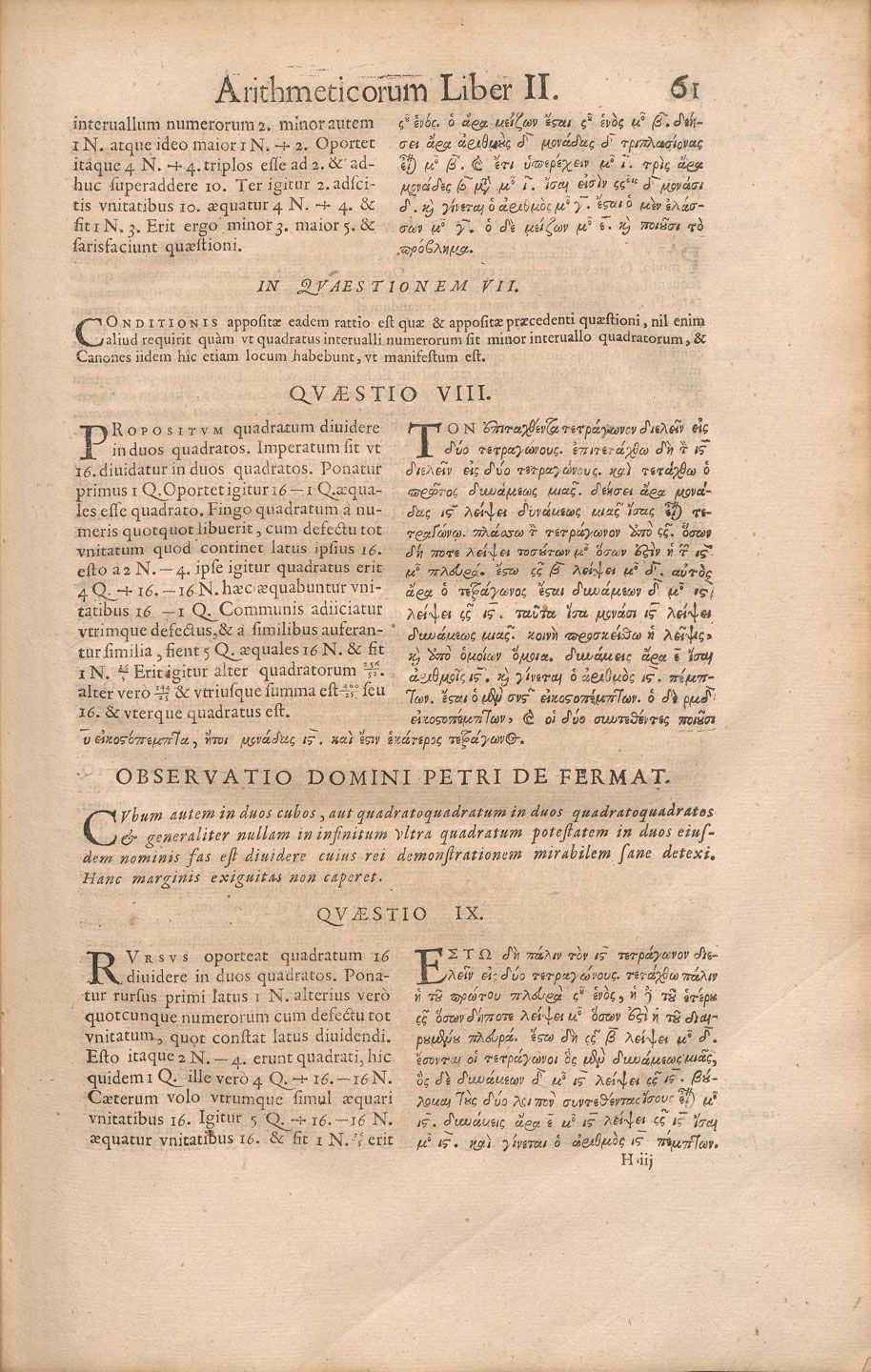
This page from the 1670 edition reproduces the famous note beside Problem II.8. It is not Fermat’s original handwritten copy, which does not survive.
View the image and source record at Wikimedia Commons →xⁿ + yⁿ = zⁿ
Around 1637, Pierre de Fermat wrote beside a problem in Diophantus’s Arithmetica that no whole-number power higher than a square can be divided into two powers of the same degree. He added that he possessed a proof, but that the available space could not hold it. No general proof in Fermat’s hand was ever found, and that tiny sentence set a problem before mathematics that remained unsolved for more than three centuries.
FAR BEYOND THE MARGIN
The solution that was finally published looked nothing like a clever trick Fermat could have squeezed between two lines.
Andrew Wiles announced a proof in 1993 after roughly seven years of largely secret work. When a gap was discovered, he repaired it with Richard Taylor. The completed argument appeared in 1995 as two consecutive papers in the Annals of Mathematics: Wiles’s main paper runs 109 pages, and the Taylor–Wiles companion adds another 20.
Rather than attacking Fermat’s equation head-on, the proof passes through highly advanced worlds—elliptic curves, modular forms, Galois representations, and Hecke algebras. It establishes enough of the modularity conjecture that, through earlier work by Frey, Serre, and Ribet, Fermat’s Last Theorem follows. The distance between a few marginal lines and this monumental architecture is what makes Fermat’s claim so irresistible—and so doubtful.
MAIN PAPER
pages
COMPANION PAPER
20 pages
THREE HIDDEN QUESTIONS
The poem playfully treats three mysteries as though they have been solved: whether aliens exist, where Carmen Sandiego is, and what became of the Lost Colony of Roanoke. All three can be found hidden on this page. One requires entering the right clue below.
A HIDDEN DISCOVERY
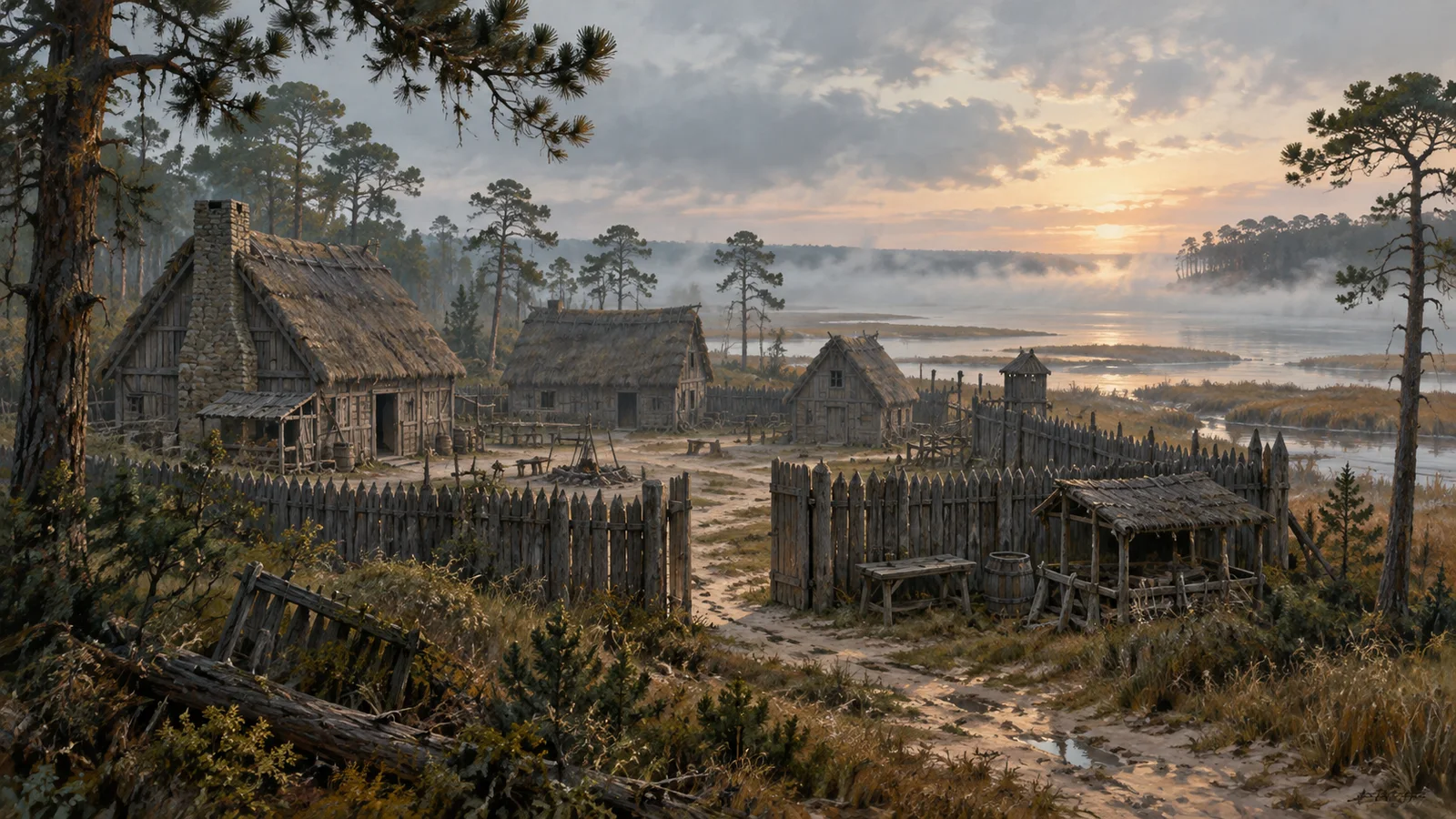
The Lost Colony of Roanoke
This scene is imagined, not a historical reconstruction. CROATOAN was carved into a post at the abandoned settlement. Read the history of the clue at the National Park Service →
READER DISCUSSION
This poem may have more to say.
Follow updates to this poem
No comments have been published yet. You can be the first reader to respond.