

POEM + COVER

On Black Holes

AUTHOR NARRATION

Hear the poem.

Read by the author in the original English.

On Black HolesEnglish narration

AN INTERACTIVE EXHIBIT

A Dot of Black

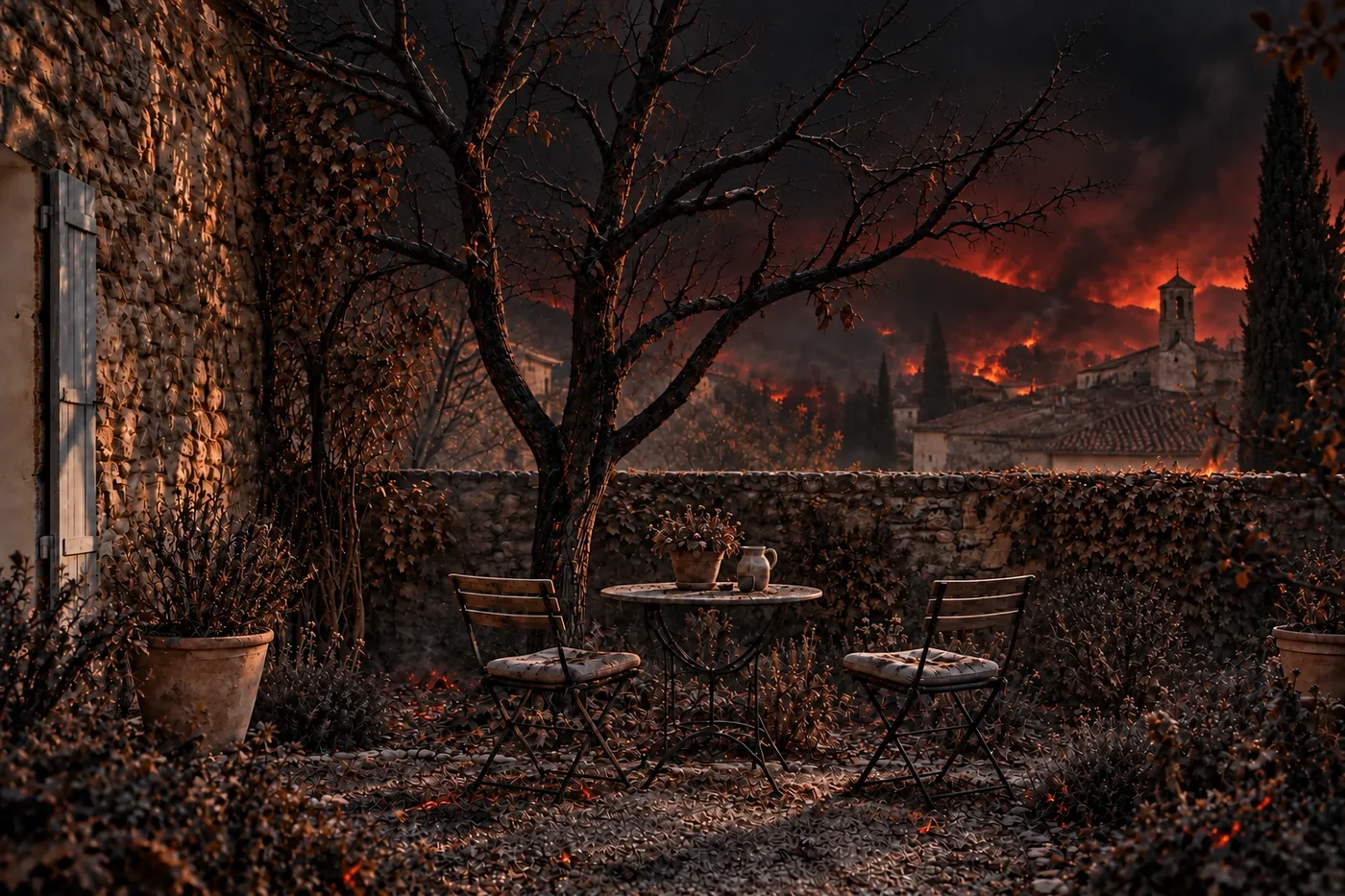
Move the darkness with your cursor as it folds down to a speck, then watch its pull unfold.

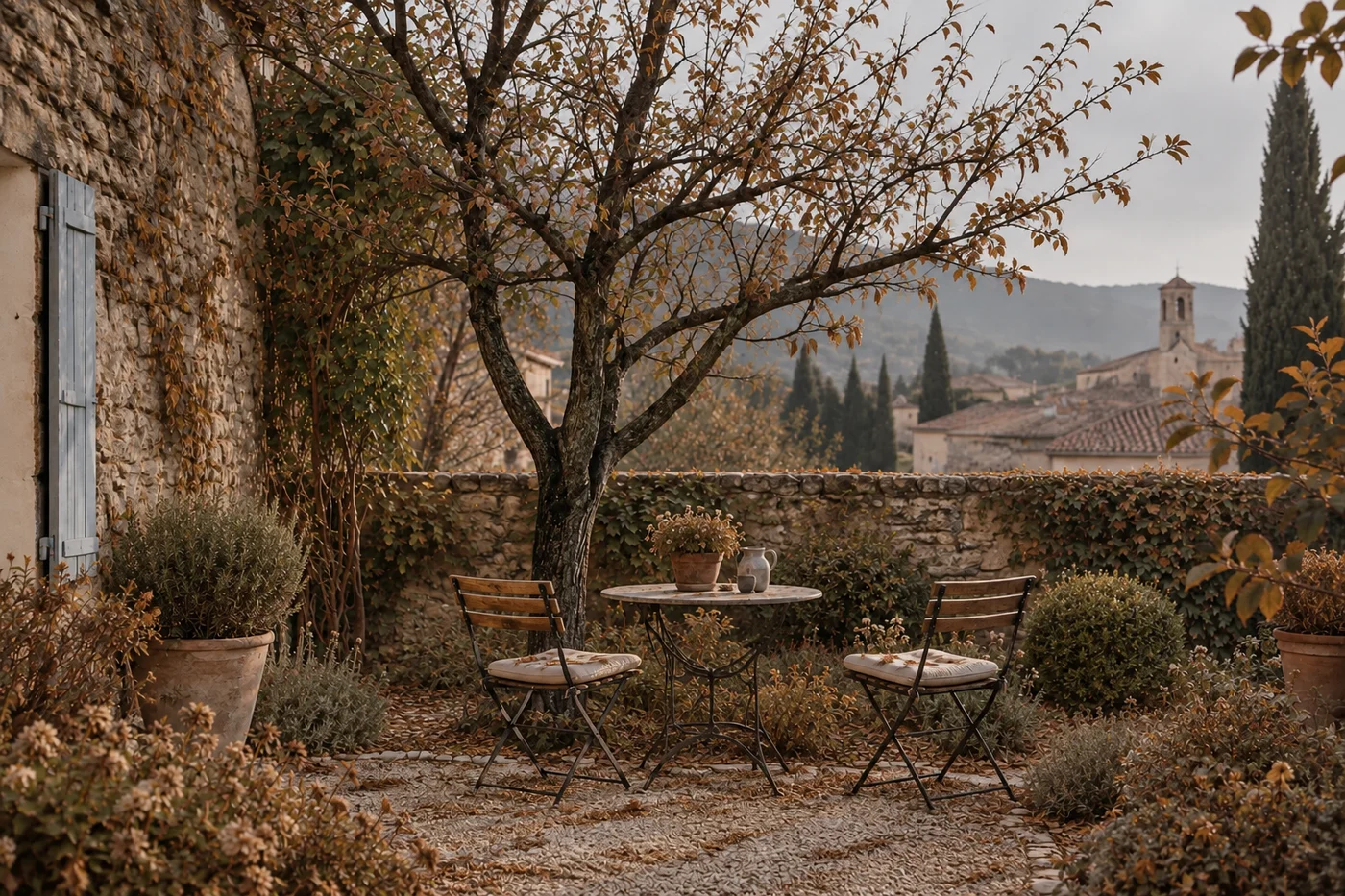
A sunlit courtyard with a flowering tree, a small table, and two empty chairs.

Move the darkness over the image.

my own?— it's held at bay
FOLD BY FOLD

The dark circle folds down to a speck as color returns, then its pull grows on its own. Move it around the image, or pause and drag the timeline to hold a particular moment.

AN ECHO OF THE POEM

The Candle Trails

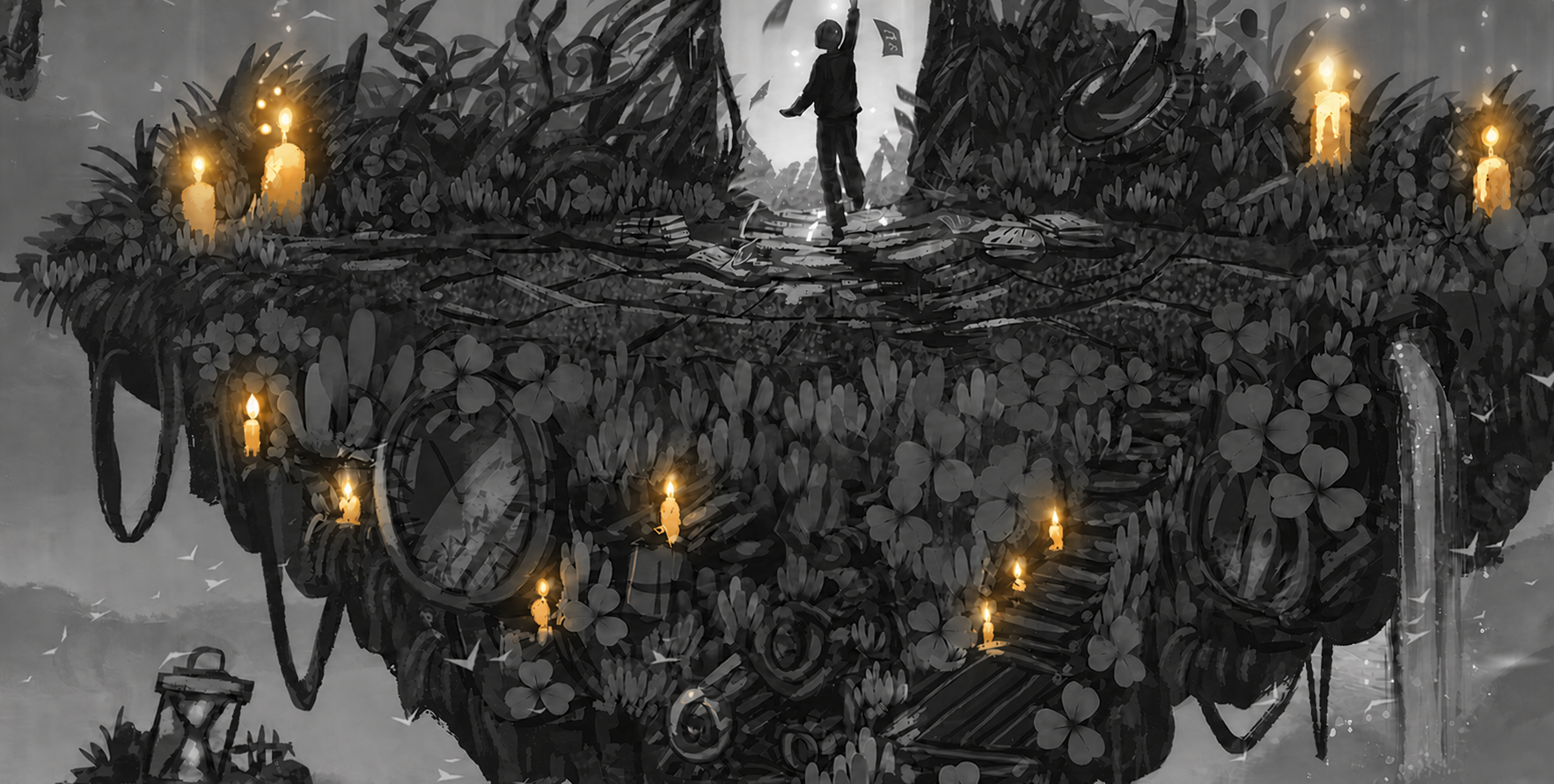
The cover of Clock Counting takes its main visual inspiration from the title poem and the song lyrics it references. But because “On Black Holes” opens the collection and remains central to my poetry, candles were added to the illustration as a small visual nod to this poem.

Detail from the Clock Counting cover illustration: a figure crosses a luminous floating landscape scattered with candles.
01
The candles in the cover

Hover over the image — or focus it with the keyboard — to isolate the candles in the illustration.

A DELIBERATE CONTRADICTION

Meandered Geodesics

A mathematical term for the most direct route is made to wander.

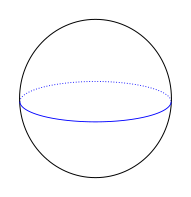
Diagram of a sphere with a geodesic drawn as a great circle.
01
A geodesic on a sphere

On a sphere, great circles are geodesics: paths that are intrinsically straight even though they look curved from outside the surface.

Most poetry readers probably do not encounter the mathematical meaning of “geodesic” very often. In geometry, a geodesic is a curve that represents the locally shortest — or intrinsically straightest possible — path between points on a surface or through a curved space. It generalizes the ordinary straight line: on a sphere, for example, great circles are geodesics.

That makes “meandered geodesics” a purposeful contradiction. To meander is to wander, detour, or take an indirect course; a geodesic is defined by intrinsic directness.

Definition and mathematical context
“Sphere geodesic” diagram by Mathwriter2718, Wikimedia Commons, CC0.

The Weight of Nothing

In physics, a black hole is not an empty opening but a region where matter is concentrated so intensely that it creates an event horizon from which even light cannot escape.

THE PHENOMENON

According to general relativity, what we experience as gravity is the curvature of spacetime around mass and energy. In a black hole, enough matter has been compressed into a small enough region to create an event horizon: a boundary beyond which every possible path through spacetime leads farther inward. Escaping would require traveling faster than light, so neither matter nor light can return once it crosses that horizon. The black hole itself is therefore dark; astronomers find it indirectly through the motion of nearby stars and gas, the light bent around it, and the radiation produced by matter before it falls in.

IN THE POEM

That physics gives the poem’s darkness a particular force. The repeated folding “in half and half again” resembles compression: something vast is reduced to “a speck” without losing its weight. The final “dot of black” is not mere absence. Like a black hole, it is unseen yet legible through what it does — bending thought around itself, holding a history inside, and exerting a “sinister gravity” on everything near it. The closing question — “is it dark magic or mere physics which makes nothing so heavy?” — therefore rests on a paradox that is both scientific and emotional: what appears to be nothing can still organize the space around it.

POEM, COMMENTARY, PUZZLE

… such pale fires incremental …

This line of the poem is intended to be a nod to Nabokov’s Pale Fire.

Pale Fire

Vladimir Nabokov · 1962

Published in 1962, Vladimir Nabokov’s Pale Fire presents a 999-line poem by the fictional poet John Shade, followed by a foreword, extensive commentary, and an index supplied by Shade’s self-appointed editor, Charles Kinbote. As Kinbote’s increasingly eccentric notes overtake the poem with his own obsessions, the book becomes a darkly comic literary puzzle about authorship, interpretation, and unreliable narration.

See the cover and buying options from the publisher
Pale Fire on Goodreads

READER DISCUSSION

Share some words about these words.

Share a response to the poem. Comments appear after moderation.

No comments have been published yet. You can be the first reader to respond.

Maximum 2,000 characters. Links are not accepted.

No account or email address is required. Comments appear after approval.

This poem may have more to say.

Follow updates to this poem