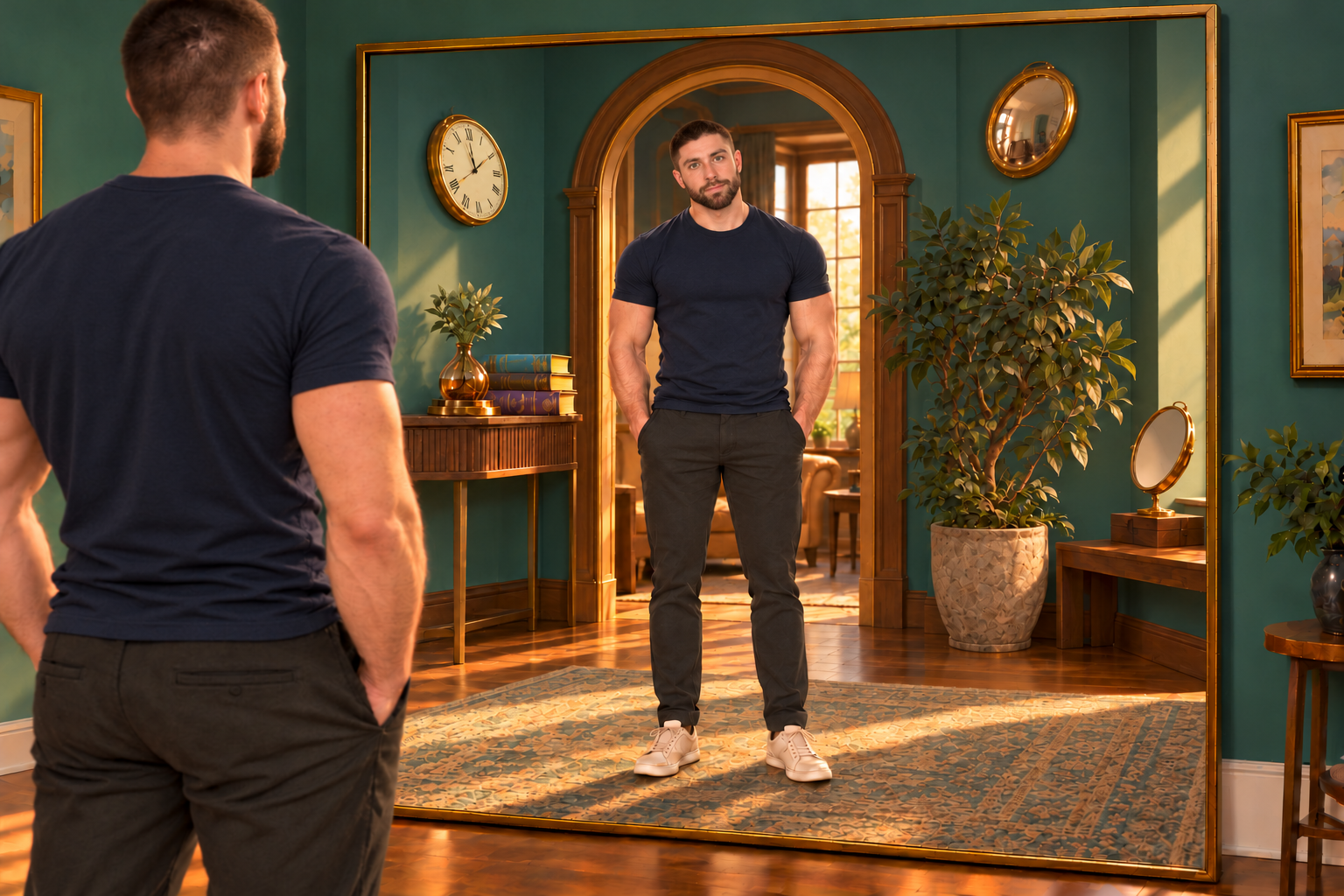
L’auteur devant un miroir dans une pièce chaleureuse.
LECTURE PAR L’AUTEUR
Écoutez le poème.
Lu par l’auteur dans la version anglaise originale.
Reflections on Thinking about ThinkingLecture en anglais
À propos de ces mots manuscritsVous pouvez aussi toucher une ligne dans le miroir.
C’est un véritable vers d’un poème que je n’ai jamais publié, intitulé , reproduit ici dans ma propre écriture. — A.F. King
UNE EXPÉRIENCE AVEC LES MOTS
renvoyés / dévoyés
L’expérience ci-dessous met cette métaphore en mouvement. Envoyez les lettres vers un hémisphère parfait ou un cratère irrégulier, puis observez où elles rebondissent.
et nulle symétrie ne se dessine là-dedans.
de sorte que les échos des poèmes et des prières
ne sont pas renvoyés,
mais,plutôt,dévoyés.
chacun perdu selon son propre angle solitaire.
CHOISIR LES MOTS
À quoi pensons-nous ?
✦
TIRÉ DE CLOCK COUNTING
Ce texte reste dans votre navigateur ; il n’est pas envoyé au concours.0 / 500
✦
HÉMISPHÈRE PARFAIT
Envoyez les lettres pour voir ce que renvoie le cratère.
00
La loi de réflexion est identique dans les deux cas : seule la forme du bord change. Changez de forme pour rejouer le même texte ; choisissez encore « Imparfait » pour créer un nouveau bord.
Une traduction mot à mot peut transmettre le sens de chaque mot et perdre pourtant ce qui fait un poème : sa cadence, ses rimes, ses consonances, etc. Les versions réunies ici ne cherchent donc pas l’équivalence littérale. Elles tentent de porter à la fois le sens sémantique et phonétique du poème entier, quitte à déplacer certains mots ou certaines images pour que sa musique passe dans une autre langue.
Explorez les versions ci-dessous — ou proposez la vôtre.
✦Dans le menu des langues, cette étoile signale un concours de traduction en cours doté d’un prix en espèces.
thought
La traduction gagnante s’affiche en premier. Découvrez aussi d’autres voix, partagées avec leur accord.
English / VERSION DISPONIBLE
Reflections on Thinking about Thinking
EN
thinking about thinking
is quite useful when donesparingly.
more than that,
and one is apt
to become lost in abstract territory,
sprung from this recursive introspection
into the suffocating expanse of an endless mind.
when the heart is left untended to,
thinking about thinking is the crater left behind:
nothing will grow here
for at least a thousand years,
and it's not even a perfect hemisphere,
so that the echoes of poems and prayers
are not reflected,
but,rather,misdirected.
each lost at its own lonely angle.
Lu par A.F. King
Le poème original d’A.F. King.
Français / VERSION DISPONIBLE
Réflexions sur « penser à la pensée »
FR
Survolez les passages marqués ✦, touchez-les ou placez-y le focus pour découvrir les choix de traduction.
CHOIX DE TRADUCTIONL’anglais répète l’activité de penser. Ici, le second terme devient le nom « la pensée », ce qui rend la formule plus contemplative et un peu moins récursive.
thinking about thought
est très utile quand on le faitCHOIX DE TRADUCTION« Avec parcimonie » se rapproche davantage de « sparingly ». « Avec sobriété » garde l’idée de mesure, avec des sons en t et en r que l’on retrouve dans « territoire abstrait ».
is very useful when one does it with restraint.
au-delà de cela,
beyond that,
et l’on est susceptible
and one is liable
de se perdre en territoire abstrait,
to get lost in abstract territory,
jailli de cette introspection récursive
sprung from this recursive introspection
dans l’étendue suffocante d’un CHOIX DE TRADUCTION« Esprit » peut évoquer à la fois l’intellect et l’âme. Nous avons gardé cette légère ambiguïté ; « sans fin » annonce aussi l’écho avec « en son sein » plus bas..
into the suffocating expanse of a mind without end.
quand le cœur est laissé là, sans soin,
when the heart is left there, without care,
penser à la pensée creuse un cratère CHOIX DE TRADUCTIONEn anglais, le cratère est « left behind » : laissé derrière soi. Ici, il se creuse à l’intérieur de l’esprit, tandis que « sein » répond par le son à « fin ». :
thinking about thought digs a crater inside it:
rien ne poussera ici
nothing will grow here
pendant au moins mille ans,
for at least a thousand years,
et CHOIX DE TRADUCTIONL’anglais dit que le cratère n’est « même pas un hémisphère parfait ». Le français remplace cette forme précise par l’absence de symétrie : la géométrie demeure, et « mille ans » rime avec « là-dedans ». ne se dessine là-dedans.
and no symmetry takes shape in there.
de sorte que les échos des poèmes et des prières
so that the echoes of poems and prayers
ne sont pas renvoyés,
are not sent back,
mais,plutôt,CHOIX DE TRADUCTION« Reflected / misdirected » devient « renvoyés / dévoyés ». La rime fait entendre les échos ; « dévoyés » suggère qu’ils sont détournés de leur route.
but, rather, led astray.
chacun perdu selon son propre angle solitaire.
each lost according to its own lonely angle.
Lu en français par A.F. King
Italiano / TRADUCTION GAGNANTE · 2026
pensare al pensare
Traduction : Anonymous
IT
Survolez les passages marqués ✦, touchez-les ou placez-y le focus pour découvrir les choix de traduction.Les annotations résument les notes fournies par la personne qui a traduit le poème.
pensare al pensare
thinking about thinking
CHOIX DE TRADUCTIONLa personne qui a traduit le poème a choisi cette expression concise, légèrement littéraire, pour « is quite useful », afin de garder une cadence chantante avant la pause., se lo si facon parsimonia.
is very useful, if one does it with restraint.
oltre quel limite,
beyond that limit,
si è inclini
one is inclined
a smarrirsi in CHOIX DE TRADUCTION« Terres abstraites » remplace le plus neutre territorio. Avec scagliati (« projetés ») dans la strophe suivante, ce choix conserve la sensation d’être lancé dans une étendue inconnue.,
to lose oneself in abstract lands,
CHOIX DE TRADUCTION« Projetés » garde la force de « sprung » : la pensée nous lance dans l’étendue étouffante de l’esprit. da questa introspezione ricorsiva
hurled by this recursive introspection
nella vastità soffocante di una mente senza fine.
into the suffocating vastness of an endless mind.
quando il cuore resta CHOIX DE TRADUCTIONIncolto désigne une terre inculte ou laissée à l’abandon. Le cœur devient ainsi un champ négligé, annonçant le cratère où rien ne poussera pendant mille ans.,
when the heart remains uncultivated,
pensare al pensare è il cratere che rimane:
thinking about thinking is the crater that remains:
qui non crescerà nulla
nothing will grow here
per almeno mille anni,
for at least a thousand years,
e non è nemmeno un emisfero perfetto,
and it is not even a perfect hemisphere,
così che gli echi di poesie e preghiere
so that the echoes of poems and prayers
non vengono riflessi,
are not reflected,
ma,piuttosto,CHOIX DE TRADUCTION« Misdirected » devient dispersi (« dispersés »). Ce choix fait écho à riflessi et évoque des sons qui se dispersent sans jamais revenir.
but, rather, scattered.
CHOIX DE TRADUCTIONAngolo devient un « coin de solitude », tout en gardant une trace de l’angle géométrique. Sperduto évoque l’égarement et la détresse plutôt qu’une perte définitive ; ses sons en s se prolongent dans suo et solitudine.
each one forlorn in its corner of solitude.
Deutsch / TRADUCTION GAGNANTE · 2026
CHOIX DE TRADUCTIONAndreas a préféré Reflexionen à Gedanken ou Überlegungen pour conserver à la fois l’image des reflets et le jeu de mots du titre. zum Nachdenken über das Denken
Survolez les passages marqués ✦, touchez-les ou placez-y le focus pour découvrir les choix de traduction.Les annotations résument les notes fournies par la personne qui a traduit le poème.
über das Denken nachzudenken
to think about thinking
ist recht nützlich, wenn es sparsamCHOIX DE TRADUCTIONAndreas associe geschieht à Gebiet, à la fin de la strophe suivante, pour retrouver un écho sonore de « sparingly / territory ».
is quite useful when it happens sparingly.
CHOIX DE TRADUCTIONAprès avoir envisagé deux variantes, Andreas a préféré mehr / sehr pour son naturel et le retour du son -er dans verlieren.
if one does more,
ist man sehr geneigt,
one is very inclined,
sich zu verlieren in abstraktem CHOIX DE TRADUCTIONCette fin de vers répond à geschieht dans la première strophe, prolongeant le jeu sonore au-delà de la séparation entre les strophes.
to lose oneself in abstract territory,
entsprungen dieser rekursiven CHOIX DE TRADUCTIONSelbstreflexion garde l’image du reflet dans le mot qui désigne l’introspection, prolongeant le choix fait dans le titre.
sprung from this recursive self-reflection
hinein in die erstickende Expansion eines Geistes, endlos und CHOIX DE TRADUCTIONAndreas fait répondre weit au zurückbleibt de la strophe suivante pour retrouver un écho de « mind / behind ».
into the suffocating expansion of a mind, endless and wide.
wenn man das Herz sich selbst überlässt,
when one leaves the heart to itself,
ist über das Denken nachzudenken der Krater, der zurückbleibt:
thinking about thinking is the crater that remains:
wachsen wird hier nichts, es wäre
nothing will grow here; it would be
für mindestens tausend Jahre leer,
empty for at least a thousand years,
und er ist nicht mal eine perfekte CHOIX DE TRADUCTIONLa suite wäre / leer / Hemisphäre / Gebete recherche une famille de sonorités proches pour « here / years / hemisphere / prayers ».
and it is not even a perfect hemisphere,
sodass die Echos der Gedichte und Gebete
so that the echoes of poems and prayers
nicht CHOIX DE TRADUCTIONLittéralement « être renvoyés » : Andreas associe cette expression à fehlgeleitet wären pour garder l’image des échos renvoyés ou déviés, ainsi que la sonorité de la fin anglaise.
are not thrown back,
sondern,eher,CHOIX DE TRADUCTIONCette formule répond à zurückgeworfen werden : les échos seraient déviés au lieu d’être réfléchis. Le traducteur a choisi cette paire pour sa sonorité comme pour son image.
but, rather, would be misdirected.
Jedes verloren in seinem eigenen einsamen Winkel.
Each one lost in its own lonely angle.
Lu par Andreas Koellner
Српски / TRADUCTION GAGNANTE · 2026
Промишљање о размишљању о размишљању
Traduction : Владимир Живановић
SR
размишљање о размишљању
thinking about thinking
прилично је корисно ако се радис мером.
is quite useful if done in moderation.
ко прекорачи меру
whoever exceeds the measure
у том смеру
in that direction
може залутати на територију апстракције,
may stray into the territory of abstraction,
изникле из ове рекурзивне интроспекције
grown from this recursive introspection
у загушљиво пространство бескрајног ума.
into the suffocating expanse of an endless mind.
када се срце остави без надзора,
when the heart is left unsupervised,
размишљање о размишљању је кратер који остаје за њим:
thinking about thinking is the crater that remains behind it:
ништа ту неће израсти
nothing will grow there
барем хиљаду година,
for at least a thousand years,
а није чак ни савршена полусфера,
and it is not even a perfect hemisphere,
па се одјеци песама и молитава
so the echoes of poems and prayers
од ње не одбијају,
do not bounce back from it,
већ,напротив,расејавају.
but, on the contrary, scatter.
сваки изгубљен под својим усамљеним углом.
each lost at its own lonely angle.
Notes de traduction (en anglais)
more than that,
and one is apt
-- becomes closer in meaning to:
who crosses the line
in that direction
-- for brevity and rhyme.
are not reflected,
but, rather, misdirected.
-- becomes:
are not reflected,
but, rather, dispersed.
-- again, to have some semblance of rhyme close to the original
For the title, instead of reflection, I used a Serbian word „promišljanje/промишљање”. But it can also be „Refleksija o razmišljanju o razmišljanju/Рефлексија о размишљању о размишљању”.
Lu par Владимир Живановић
Српски / DEUXIÈME PLACE · 2026
Размишљања о размишљању о размишљању
Traduction : Vanesa Vaštag
SR
размишљање о размишљању
thinking about thinking
може бити корисно ако се ради
can be useful if done
умерено.
in moderation.
штавише,
moreover,
човек је склон ка томе да се
a person is inclined to
изгуби на апстрактној територији
get lost in abstract territory
која се од вечитог самопосматрања
which, from perpetual self-observation,
претворила у загушљив простор бесконачног ума.
has turned into a suffocating space of an infinite mind.
када је срце занемарено,
when the heart is neglected,
размишљање о размишљању постаје рупа
thinking about thinking becomes a hole
у којој ништа неће да расте
in which nothing will grow
бар једно хиљаду година,
for at least something like a thousand years,
и чак није ни савршена полулопта,
and it is not even a perfect hemisphere,
тако да одјеци песама и молитва
so the echoes of poems and prayers
не одзвањају,
do not resound,
већ су усмерениу погрешан правац.
but are directed in the wrong direction.
сваки изгубљен под својим усамљеним углом.
each lost at its own lonely angle.
Notes de traduction (en anglais)
In order to achieve a native sounding translation, I have used equivalents in the Serbian language. For instance, "echo" could be translated as "eхo", I used "одјек", "introspection" could be "introspekcija", but I chose "самопосматрање", and also in the title I chose “размишљање“ for „reflections“ (so that I have this whacky title in Serbian). I believe that, if there is an equivalent to a word in the target language, then it should also be used. On top of that loan words are mostly used in scientific papers and academic writing/speech, and keeping them in this translation would make the poem sound like an academic paper, and not really native.
I didn’t change the phrase "abstract territory". "Abstract" means theoretical, mental, hypothetical, unreal, abstruse, complex; in Serbian: mislen, nepostojeći, pojmovni, izmišljen, složen, nerazumljiv. If I had chosen only one of those, it would exclude the others from the translation. The same applies to the word “territory”.
I have changed the part “into the suffocating expanse of an endless mind” to “загушљив простор бесконачног ума. / a suffocating space of an endless mind”. While I strived for equivalents in Serbian, here the equivalents for “expense” would be “posledica, cena”, and in a sentence “u cenu/posledicu beskočanog uma koja guši”, they would change the structure and, in my opinion, also the rhythm and imagery of the poem. Adittionally in Serbian we are more likely to say that a space is suffocating, rather than an expense.
By addapting the verse „thinking about thinking is the crater left behind„ into „размишљање о размишљању постаје рупа (lit. whole)“ / thinking about thinking turns into a crater“, I have connected it with „when the heart is left untended to“, because I understood it as a process of neglecting the heart, which turned the „thinking about thinking“ into a crater.
Last but not least, I used particles such as “bar”, “ni”, “čak”, “jedno” to either convey a mood or emphasize something, which is pretty common in the Serbian language making the poem sound more native.
Aucune lecture audio fournie.
Italiano / UNE AUTRE VOIX · 2026
pensare al pensiero
Traduction : Sammartino
IT
pensare al pensiero
thinking about thought
può aiutare se fattomoderatamente.
can help if done moderately.
nulla più di questo,
nothing more than this,
o è facile trovarsi
or it is easy to find oneself
scomparsi in un territorio astratto,
disappeared in an abstract territory,
scagliati da quest'introspezione ricorsiva
hurled from this recursive introspection
nel soffocante vuoto di una mente infinita.
into the suffocating emptiness of an infinite mind.
quando il cuore viene trascurato,
when the heart is neglected,
pensare al pensiero è il cratere che resta:
thinking about thought is the crater that remains:
niente crescerà qui
nothing will grow here
per almeno mille anni,
for at least a thousand years,
e non è neppure un perfetto emisfero,
and it is not even a perfect hemisphere,
cosicché gli echi di versi e preghiere
so that the echoes of verses and prayers
non vengono riflessi,
are not reflected,
ma,piuttosto,deviati.
but, rather, diverted.
ognuno disperso, solitario, nel suo angolo.
each one scattered, solitary, in its corner.
Deutsch / UNE AUTRE VOIX · 2026
gedanken zum denken über das denken
Traduction : Klaus Urban
DE
über das denken nachzudenken
to think about thinking
ist durchaus nützlich, solange man es sparsam tut.
is certainly useful, as long as one does it sparingly.
und mehr noch,
and more still,
man verirrt sich leicht
one easily loses one’s way
in abstrakten landschaften,
in abstract landscapes,
entsprungen aus dieser rekursiven selbstbetrachtung
sprung from this recursive self-contemplation
in die beklemmende weite eines endlosen geistes.
into the oppressive expanse of an endless mind.
wenn das herz allein gelassen wird,
when the heart is left alone,
bleibt vom denken übers denken nur ein krater zurück:
only a crater remains from thinking about thinking:
nichts wächst hier mehr
nothing grows here anymore
für mindestens tausend jahre,
for at least a thousand years,
und er ist nicht einmal eine perfekte hemisphäre,
and it is not even a perfect hemisphere,
so dass die echos von gedichten und gebeten
so that the echoes of poems and prayers
nicht zurückgeworfen,
are not thrown back,
sondernfehlgeleitet werden.
but are misdirected.
ein jedes verloren in seinem eigenen einsamen winkel.
each one lost in its own lonely corner.
Deutsch / UNE AUTRE VOIX · 2026
Übers Denken nachzudenken
Traduction : Christian Schwetz
DE
Übers Denken nachzudenken
To think about thinking
ist recht nützlich,in Maßen.
is quite useful, in moderation.
Zu viel
Too much
und man könnte sich,
and one could
in abstraktem Gelände verlieren,
lose oneself in abstract terrain,
herausgeschleudert aus dieser Selbstreflexion
flung out of this self-reflection
in die beklemmende Weite eines endlosen Geistes.
into the oppressive expanse of an endless mind.
Wenn das Herz unbeachtet bleibt,
If the heart remains unheeded,
ist Nachdenken übers Denken der zurückbleibende Krater:
thinking about thinking is the crater left behind:
Hier wird nichts wachsen
Nothing will grow here
für mehr als tausend Jahre,
for more than a thousand years,
es ist nicht mal eine polierte Hirnschale,
it is not even a polished skullcap,
sodass die Echos von Gedichten und Gebeten
so that the echoes of poems and prayers
nicht reflektiert werden,
are not reflected,
sondernvielmehrin die Irre geleitet.
but rather led astray.
Jedes verloren im eigenen einsamen Winkerl.
Each one lost in its own lonely little corner.
Deutsch / UNE AUTRE VOIX · 2026
Nachdenken über Nachdenken kann nützlich sein
Traduction : Anna Sanner
DE
Nachdenken über Nachdenken
Thinking about thinking
kann nützlich sein wenn man es sparsam macht
can be useful if one does it sparingly
Zu viel davon
Too much of it
führt leicht dazu
easily leads to
sich zu verlieren in abstraktem Territorium
losing oneself in abstract territory
entsprungen aus der rekursiven Selbstbetrachtung dieser Zeilen
sprung from the recursive self-contemplation of these lines
in die erstickend tiefe Weite eines endlosen Bewusstseins.
into the suffocatingly deep expanse of an endless consciousness.
Vergisst man hier sein Herz
If one forgets one’s heart here
bleibt nur der Krater Nachdenken über Nachdenken zurück
only the crater of thinking about thinking remains
Nichts wird dort wachsen
Nothing will grow there
die nächsten tausend Jahre nicht,
not for the next thousand years,
nicht mal eine halbrunde Sache ist er,
it is not even a semicircular thing,
so dass die Echos von Gedichten und Gebeten
so that the echoes of poems and prayers
nicht reflektiert
are not reflected
sondernverschossen werden
but are shot away
ein jedes einsam und allein verlorn in seinem Winkel
each one lonely and alone, lost in its corner
Deutsch / UNE AUTRE VOIX · 2026
Nachdenken über’s Denken
Traduction : C.A. Wiertz
DE
Nachdenken über’s Denken
Thinking about thinking
ist nützlich, wenn es mit Zurückhaltung geschieht,
is useful when it happens with restraint,
ansonsten
otherwise
riskiert man,
one risks
sich in der tödlichen Öde der Abstraktion zu verlieren -
losing oneself in the deadly desolation of abstraction —
Introspektion in der Wiederholungsschleife
Introspection in the repetition loop
des endlosen Bewusstseins.
of endless consciousness.
Wenn das Herz aussen vor bleibt,
If the heart is left out,
ist Nachdenken über’s Denken wie ein Krater:
thinking about thinking is like a crater:
Nichts wird hier wachsen
Nothing will grow here
für tausend Jahre oder länger,
for a thousand years or longer,
und es ist ja nicht einmal eine perfekte Hemisphäre,
and it is not even a perfect hemisphere,
so dass der Widerhall von Gedichten und Gebeten
so that the reverberation of poems and prayers
nicht reflektiert wird,
is not reflected,
sondernmissgeleitet,
but misdirected,
ein jedes verloren gegangen an seinem eignen einsamen Brechungswinkel.
each one lost at its own lonely angle of refraction.
Deutsch / DEUXIÈME PLACE · MEILLEURE TRADUCTION PHONÉTIQUE · 2026
Reflexionen zum Denken über das Denken
Traduction : Frank Wittmer
DE
Survolez les passages marqués ✦, touchez-les ou placez-y le focus pour découvrir les choix de traduction.Les annotations résument les notes fournies par la personne qui a traduit le poème.
CHOIX DE TRADUCTIONFrank reprend le nombre de syllabes et le rythme des deux premiers vers. Ses contractions « übers » et « man's » maintiennent un ton parlé, en accord avec la contraction « it’s » qui apparaît plus loin dans le poème anglais.
thinking about thinking
ist CHOIX DE TRADUCTIONIci, « schon » renforce l’affirmation (« bel et bien ») ; Frank ne l’emploie pas au sens temporel de « déjà ». nützlich, wenn man'ssparsam macht
is indeed useful when one does it sparingly
und zudem
and moreover
ist man geneigt,
one is inclined
sich zu verirren auf abstraktem CHOIX DE TRADUCTIONFrank préfère « Terrain » à « Gebiet » et au lourd « Territorium », qui compte cinq syllabes. Son r répond à la fricative uvulaire de « verirren » et d’« abstrakt », créant un lien sonore.
to lose one’s way on abstract terrain
entsprungen aus dieser rekursiven innenschau
sprung from this recursive introspection
in die erstickende weite eines endlosen geistes
into the suffocating expanse of an endless mind
wenn das herz unbeachtet bleibt,
when the heart goes unheeded,
CHOIX DE TRADUCTIONFrank transforme le cratère « laissé derrière » en centre vide autour duquel tournent les pensées. « Kreist » forme une allitération avec « Krater » et annonce la géométrie qui suit. L’ajout « heißt es » (« dit-on ») crée une rime consonantique avec « Geistes », deux vers plus haut. denken übers denken um einen leeren krater, heißt es:
thinking about thinking circles around an empty crater, it is said:
nichts wird hier CHOIX DE TRADUCTIONLa contraction usuelle « gedeihn », plutôt que « gedeihen » ou le plus littéral « wachsen » (« pousser »), permet à Frank de rimer avec « sein » deux vers plus loin et de conserver la rime de l’original.
nothing will thrive here
für zumindest tausend jahre,
for at least a thousand years,
und es wird nicht mal ein CHOIX DE TRADUCTIONFrank choisit « glattes Halbrund » (« demi-cercle lisse ») pour sa brièveté, ses a accentués en écho à « mal » et son rythme. Selon lui, « perfekte Halbkugel » perturberait le mouvement trochaïque calme de « perfect hemisphere », tandis que « Hemisphäre » compte quatre syllabes. Son vers conserve les onze syllabes et le schéma accentuel de l’original, avec la chute dactylique de « nicht mal ein » à la place de « even a ». sein
and it will not even be a smooth semicircle
so wird der CHOIX DE TRADUCTIONFrank considère que l’allemand « Echo » est plus précis que le mot anglais. Il emploie d’abord « Hall » (« résonance »), plus général, puis « Echo » au vers suivant pour conserver les deux associations. Il y voit une distinction de sens plutôt qu’une répétition redondante. der gedichte und gebete
thus the reverberation of poems and prayers
nicht als echo reflektiert,
is not reflected as an echo,
sondernzerstreutCHOIX DE TRADUCTIONL’expression dédoublée « zerstreut und weggeführt » (« dispersé et détourné ») préserve la dernière rime, centrale, avec « reflektiert » au vers précédent.
but scattered and led away
jedes im eigenen CHOIX DE TRADUCTIONFrank évite « einsamer Winkel » : bien que « Winkel » désigne un angle géométrique, l’expression évoque aussi quelqu’un assis dans un « coin solitaire ». Isoler « Winkel » préserve la géométrie. « Abgeprallt » (« ayant rebondi ») prolonge l’image acoustique des vers précédents, tandis que « verloren » (« perdu »), placé à la fin, exprime et souligne le « lost and lonely » de l’original. abgeprallt, verloren
each deflected at its own angle, lost
Deuxième place au concours de traduction allemande de 2026. Le choix d’A.F. King pour la meilleure transposition des sonorités, du rythme et des rimes du poème original.
Deutsch / UNE AUTRE VOIX · 2026
Über das Denken nachzudenken
Traduction : Michael Treml
DE
Survolez les passages marqués ✦, touchez-les ou placez-y le focus pour découvrir les choix de traduction.Les annotations résument les notes fournies par la personne qui a traduit le poème.
Über das Denken nachzudenken,
To think about thinking,
nutzt durchaus, bleibt esCHOIX DE TRADUCTIONMichael choisit « in Maßen » (« avec mesure ») plutôt qu’une construction littérale avec « sparsam ». La proposition poétique se termine ainsi sur la même idée que l’original, plutôt que sur un auxiliaire.
is certainly useful, if it stays in moderation.
Im CHOIX DE TRADUCTION« Übermaß » (« excès ») répond à l’expression apparentée « in Maßen » (« avec mesure »). Michael préfère ce contraste à une formule générale comme « plus que cela ». jedoch
In excess, however,
ist man geneigt,
one is inclined
CHOIX DE TRADUCTIONMichael inverse l’ordre plus courant « sich im abstrakten Gebiet zu verlieren ». Cette tournure plus poétique lui semble mieux correspondre au deuxième vers.,
to lose oneself in abstract territory,
entsprungen dieser rekursiven Selbstbetrachtung,
sprung from this recursive self-contemplation,
in die erstickende Weite eines endlosen Geistes.
into the suffocating vastness of an endless mind.
Wenn das Herz vernachlässigt wird,
When the heart is neglected,
lässt CHOIX DE TRADUCTION« Thinking about thinking » devient une longue expression en allemand. À sa deuxième apparition, Michael l’abrège en « cette pensée ». einen Krater zurück:
this thinking leaves a crater behind:
Nichts wird hier wachsen
Nothing will grow here
CHOIX DE TRADUCTIONMichael préfère « pendant mille ans ou davantage » au plus littéral « pendant au moins mille ans » pour sa sonorité poétique et son accord avec les vers précédents.
for a thousand years or more
und er ist nicht einmal CHOIX DE TRADUCTION« Rund » signifie littéralement « rond », plutôt qu’« hémisphère », mais peut aussi décrire quelque chose d’abouti et qui fonctionne bien. L’allitération « richtig rund » répond à « Gedichten und Gebeten » au vers suivant.,
and it is not even properly round,
sodass Echos von Gedichten und Gebeten
so that echoes of poems and prayers
nicht widerhallen,
do not resound,
sondern fehlgeleitet und CHOIX DE TRADUCTIONMichael déplace « verloren » (« perdu ») dans ce vers afin que les deux derniers vers gardent une longueur comparable. werden,
Gespeist aus einer rücklaufenden Selbstbeobachtung
Fed by a backward-running self-observation
In das erdrückende Trümmerfeld des endlosen Unterbewusstseins
Into the crushing field of rubble of the endless subconscious
Wenn das Herz vernachlässigt wird
When the heart is neglected
Das Denken über das Denken hinterlässt vernichtende Spuren:
Thinking about thinking leaves devastating traces:
Dort wird nichts mehr wachsen
Nothing will grow there anymore
Wenigstens für die nächsten Tausend Jahre
At least for the next thousand years
Und es ist nicht mal eine perfekte Hemisphäre
And it is not even a perfect hemisphere
So dass die Echos der Gedichte und Gebete
So that the echoes of the poems and prayers
nicht reflektiert werden
are not reflected
Sondern,eher,in die Irre geführt werden
But, rather, are led astray
Jedes verloren in seinem eigenen einsamen Winkel
Each lost at its own lonely angle
Deutsch / UNE AUTRE VOIX · 2026
Gedanken über das Überdenken
Traduction : Christina Georg-Carbon
DE
Über das Denken nachzudenken, ist sparsam, nützlich, wenn man´s
To think about thinking is sparing, useful, if one
nicht übertreibt,
does not overdo it,
doch mehr als das, neigt man dazu,
but beyond that, one tends
daß einen der Gedanke selbst sich einverleibt.
to be swallowed up by thought itself.
In abstrakten Theorien, sich selbst kritisch zu betrachten,
In abstract theories, to examine oneself critically,
um schließlich in den großen Weiten des eigenen Verstandes zu verschmachten.
only to languish at last in the vast expanses of one’s own mind.
Wenn das Herz vernachlässigt wird,
When the heart is neglected,
ist Überdenken das Einzige, das hält;
overthinking is the only thing that lasts;
ein Jahrtausend – fruchtlos; wächst nichts mehr,
a millennium — fruitless; nothing grows anymore,
fernab des Seins in unfassbarer Welt.
far from being, in an incomprehensible world.
Das Echo von Gebet und Kunst,
The echo of prayer and art,
verliert es sich und hallt nicht wieder,
it loses itself and does not resound again,
entschwindet in dem Dunst der Zeit –
vanishes into the haze of time —
entschwunden dann und kehrt nicht wieder.
then vanished, and does not return.
La traductrice indique avoir écrit elle-même cette version, sans IA, sous son nom de plume Christina Georg-Carbon.
Deutsch / UNE AUTRE VOIX · 2026
CHOIX DE TRADUCTIONPatricia choisit le courant « Überlegungen » (« considérations » ou « réflexions »), plutôt qu’une forme plus proche du son anglais mais, à son oreille, inhabituelle et distrayante. über das Bedenken des Nachdenkens
Traduction : Patricia Falkenburg
DE
Survolez les passages marqués ✦, touchez-les ou placez-y le focus pour découvrir les choix de traduction.Les annotations résument les notes fournies par la personne qui a traduit le poème.
CHOIX DE TRADUCTIONPatricia distingue « Nachdenken » (la réflexion) de « Bedenken » (l’examen), qui porte aussi une nuance d’inquiétude ou de souci. Ces préfixes évitent une simple répétition tout en conservant l’inquiétude du poème.
to consider thinking things over
ist durchaus nützlich, wenn es denn geschiehtCHOIX DE TRADUCTIONPatricia préfère « in Maßen » (« avec mesure ») à « sparsam » : elle entend la modération opposée à l’excès. Sa place finale crée une légère interruption, comme le « sparingly » isolé dans le poème anglais.
is certainly useful, if it is indeed done in moderation.
im CHOIX DE TRADUCTION« Im Übermaß » (« dans l’excès ») fait pendant à « in Maßen » (« avec mesure »). Patricia trouve ce contraste plus clair que le littéral « plus que cela ».
in excess
führt es leicht dahin, dass
it readily leads to the point where
man irregeht im abstrakten Gelände
one goes astray in abstract terrain
das, aus der rekursiven Innenschau gebildet,
which, formed from recursive introspection,
CHOIX DE TRADUCTIONPatricia ajoute « verführt » (« séduit »), car la pensée récursive lui semble une séduction ; ce mot répond aussi au précédent « führt ». Elle choisit « grenzenlos » (« sans limites ») plutôt que « endlos » (« sans fin ») pour privilégier l’espace au temps, en accord avec le cratère..
seduces one into the suffocating vastness of a boundless mind.
wird aber das Herz vernachlässigt,
but if the heart is neglected,
bleibt das Denken über Denken als Krater zurück:
thinking about thinking remains as a crater:
nichts wächst hier mehr,
nothing grows here anymore,
tausend Jahre lang und länger;
for a thousand years and longer;
so unvollkommen CHOIX DE TRADUCTIONPatricia ajoute « dann » (« alors ») pour le son et le rythme. Le dernier mot « Bahn » (« voie » ou « trajectoire ») lui répond. die halbe Kugelform,
so imperfect then the half-spherical shape,
dass CHOIX DE TRADUCTIONPatricia trouve que le littéral « dass die Echos » interrompt le rythme. « Jedes Echo » (« chaque écho ») lui semble plus fluide et annonce « jedes in seiner … Bahn » au dernier vers. von Gedichten und Gebeten
so that each echo of poems and prayers
nicht CHOIX DE TRADUCTIONPatricia choisit « zurückgeworfen » (« renvoyé ») plutôt que « reflektiert » pour sa sonorité, tout en gardant le sens de la réflexion. werden kann,
cannot be thrown back,
sondernvielmehrfehlgeleitet
but, rather, misdirected
verlorengeht, ein jedes in seiner eignen einsamen CHOIX DE TRADUCTIONPatricia comprend « angle » comme la trajectoire de quelque chose d’irrégulièrement réfléchi, poème ou prière. Elle choisit « Bahn » plutôt que « Winkel », qui peut aussi désigner un coin ou un recoin..
is lost, each in its own lonely trajectory.
Lu par Patricia Falkenburg
?
UNE PAGE À ÉCRIRE
Pas encore de version en pour le moment.
Si vous souhaitez traduire ce poème, proposez votre version ci-dessous. Je la lirai avant toute publication ; rien n’apparaît automatiquement sur le site.
✎
UNE AUTRE FAÇON DE LE DIRE
Proposer une autre version en
Vous pensez pouvoir améliorer la traduction affichée ? Envoyez la vôtre ci-dessous. La version actuelle restera en place pendant l’examen ; aucune proposition n’est publiée automatiquement.
Le but n’est pas une traduction directe, mot à mot. Google Traduction ou une IA peuvent déjà en produire une. Je cherche une version poétique réfléchie, attentive au sens et à l’émotion du poème, mais aussi à sa cadence, à ses sonorités et, si possible, à ses rimes.
Vous pouvez modifier une image ou une expression si cela préserve mieux d’autres aspects du poème dans son ensemble. Les notes facultatives ci-dessous vous permettent d’expliquer vos choix.
Ne vous souciez ni des retours à la ligne ni de l’espacement : je m’occuperai moi-même de la mise en forme.
Vous pouvez revenir à l’anglais dans le menu pour consulter le texte original.
DISCUSSION DES LECTEURS
Réfléchissez à ces réflexions.
Aucun commentaire publié pour le moment. Vous pouvez être la première personne à répondre.
Aucun commentaire publié pour le moment. Vous pouvez être la première personne à répondre.